Unexpected equipment failure can bring production to a standstill.
A failed motor, pump, compressor or critical machine can result in downtime, delayed production and expensive emergency maintenance.
Traditional maintenance approaches generally involve either repairing equipment after failure or servicing equipment at predetermined intervals.
Modern industrial automation is enabling a third approach: predictive maintenance.
What Is Predictive Maintenance?
Predictive maintenance uses equipment condition and operational data to identify potential problems before they become major failures.
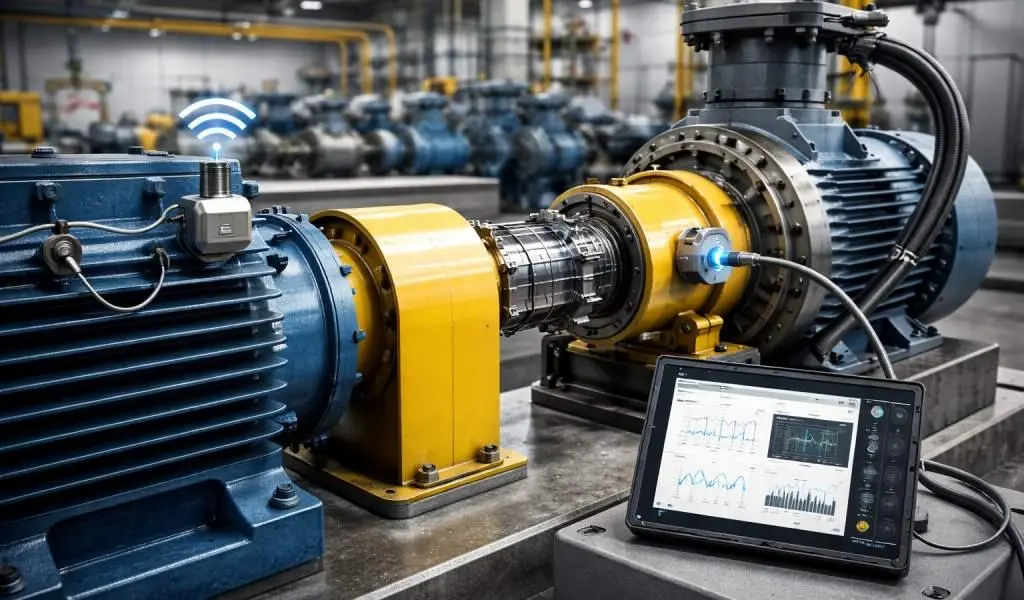
Sensors can continuously collect information such as:
- Temperature
- Vibration
- Motor current
- Pressure
- Speed
- Energy consumption
- Operating cycles
This information can then be analyzed to identify unusual behavior.
From Reactive to Predictive
Consider a production motor.
With reactive maintenance:
Motor fails → Production stops → Maintenance team responds
With preventive maintenance:
Scheduled date arrives → Motor is inspected or serviced
With predictive maintenance:
Condition changes → System detects abnormal behavior → Maintenance is planned
The objective is to identify developing problems early enough to take appropriate action.
How Automation Makes Predictive Maintenance Possible
Industrial automation systems already collect large amounts of operational data.
PLCs can provide machine status and operating parameters.
SCADA systems can store trends and alarms.
IIoT devices can collect additional equipment information.
Analytics platforms can then analyze this data to identify patterns.
This combination creates a pathway from simple monitoring to condition-based maintenance.
Where Predictive Maintenance Can Help
Predictive maintenance can be particularly useful for equipment where failure has a significant operational impact.
Examples include:
- Motors
- Pumps
- Compressors
- Gearboxes
- Fans
- Conveyors
- Production machines
- Industrial HVAC systems
The Role of IIoT
Industrial Internet of Things technologies make it easier to connect machines and sensors to data platforms.
Instead of looking at a machine only when something goes wrong, maintenance teams can monitor equipment continuously.
Recent industrial automation developments increasingly combine IIoT, SCADA, sensors and AI-based analytics for predictive maintenance and operational optimization.
Predictive Maintenance Is Not Just About AI
AI is receiving considerable attention, but successful predictive maintenance begins with good data.
A factory needs:
- Reliable sensors
- Accurate measurements
- Proper data collection
- Consistent equipment records
- Appropriate analytics
- Skilled maintenance personnel
Without reliable underlying data, even sophisticated analytics may provide limited value.
Benefits
A well-designed predictive maintenance strategy can help organizations:
- Reduce unexpected downtime
- Improve equipment reliability
- Plan maintenance activities
- Reduce emergency repairs
- Improve asset visibility
- Identify developing faults
- Extend equipment utilization
Building a Predictive Maintenance Strategy
Manufacturers do not necessarily need to connect every machine on day one.
A better approach is to identify critical assets first.
Ask:
Which machines cause the greatest production losses when they fail?
Those assets can become the starting point for condition monitoring.
Once the system proves its value, monitoring can gradually be expanded across the facility.
Conclusion
Predictive maintenance represents an important evolution in industrial maintenance.
By combining automation, sensors, connectivity and analytics, manufacturers can move from simply reacting to equipment failures toward making more informed maintenance decisions.
The ultimate goal is simple: better equipment reliability with fewer unexpected interruptions.