
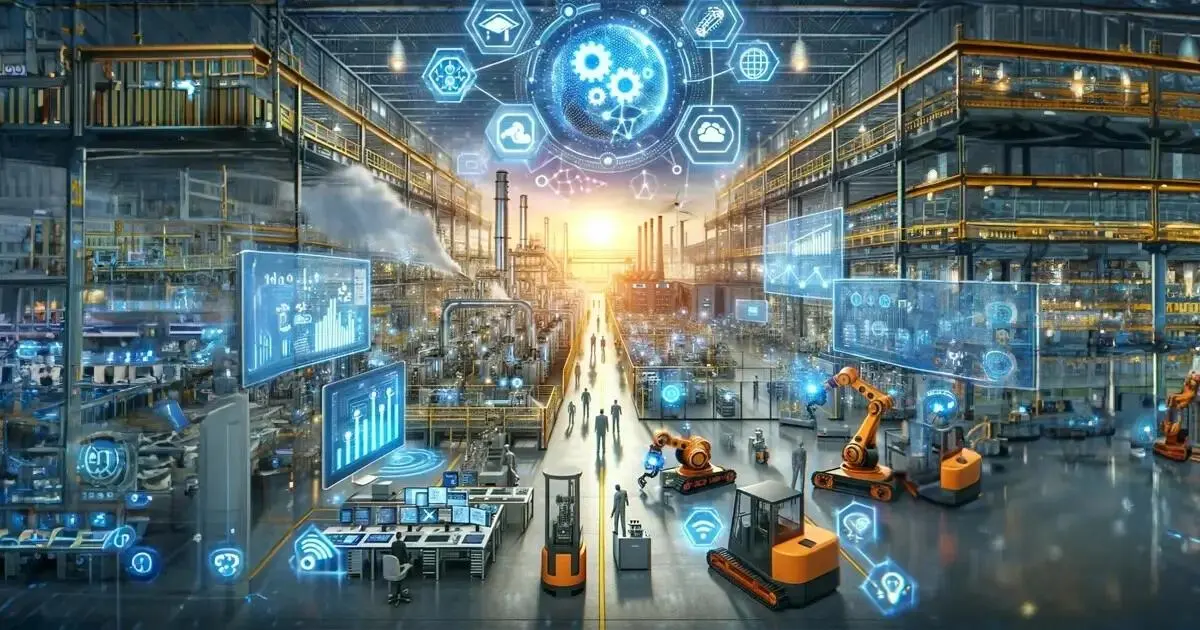
Industrial automation has evolved significantly over the past several decades.
Factories have moved from manual operations to automated machines, programmable controllers and computer-based monitoring.
The next stage is the smart factory.
A smart factory connects machines, people, processes and data to create a more visible, flexible and intelligent manufacturing environment.
What Is Industry 4.0?
Industry 4.0 refers broadly to the transformation of manufacturing through connected digital technologies.
Important technologies include:
- Industrial IoT
- Artificial Intelligence
- Machine Learning
- Robotics
- Cloud and edge computing
- Digital twins
- Advanced analytics
- Machine vision
- Connected automation systems
The International Society of Automation identifies Industry 4.0, smart manufacturing, digital twins, AI and autonomous systems among major areas shaping modern automation.
From Automated Factory to Smart Factory
An automated factory can perform tasks automatically.
A smart factory goes further.
It can collect operational information, analyze data and provide insights that help people make better decisions.
For example, a traditional automated production line may simply report:
Machine stopped.
A connected smart manufacturing system may provide:
Machine stopped → Fault identified → Historical pattern analyzed → Maintenance team alerted.
This shift from automation to intelligent decision support is one of the major changes taking place in manufacturing.
The Role of Industrial IoT
Industrial IoT connects machines, sensors and equipment to communication and data systems.
This can provide organizations with greater visibility into:
- Production
- Machine health
- Energy usage
- Quality
- Maintenance
- Process performance
Manufacturers are increasingly using IIoT alongside existing automation systems rather than replacing all legacy equipment at once.
Digital Twins
A digital twin is a digital representation of a physical asset, process or system.
It can combine operational data with models and simulations to help organizations understand how equipment or processes behave.
Digital twins are increasingly being explored for:
- Equipment optimization
- Process simulation
- Maintenance planning
- Performance analysis
- Training
- Design improvement
Robotics and Machine Vision
Robotics can automate repetitive physical tasks, while machine vision can help machines inspect products and identify visual characteristics.
Together, these technologies can support applications such as:
- Assembly
- Material handling
- Packaging
- Inspection
- Sorting
- Quality control
The goal is not simply replacing manual work. Automation can also improve repeatability, traceability and workplace safety.
The Human Role in Smart Manufacturing
Smart factories do not eliminate the need for people.
Instead, the nature of industrial jobs is changing.
Operators, technicians and engineers increasingly need skills related to:
- Automation
- PLC programming
- Industrial networking
- Data analysis
- Robotics
- Cybersecurity
- System integration
Recent industrial transformation in India is similarly creating demand for automation, robotics, data-driven quality and maintenance capabilities.
Cybersecurity Becomes More Important
As factories become more connected, cybersecurity becomes an increasingly important part of industrial automation.
Connecting machines to networks and enterprise systems can provide significant operational benefits, but those connections also need to be designed and protected appropriately.
Security should therefore be considered from the beginning of an automation project rather than added as an afterthought.
How Should a Factory Start Its Industry 4.0 Journey?
A manufacturer does not need to transform an entire factory overnight.
A practical approach is:
Step 1: Identify an important operational problem.
Step 2: Collect reliable data from the relevant equipment.
Step 3: Connect the equipment and establish visibility.
Step 4: Analyze the collected information.
Step 5: Automate or optimize the identified process.
Step 6: Expand the solution to other areas.
This gradual approach can make digital transformation more manageable and measurable.
Conclusion
Industry 4.0 is not simply about buying the newest technology.
It is about connecting automation, data and people to make manufacturing more efficient, responsive and intelligent.
The factories of the future will increasingly combine automation systems with IIoT, analytics, robotics and AI to create connected manufacturing environments.
For businesses preparing for the next stage of industrial growth, building a strong automation foundation today can provide an important starting point for tomorrow’s smart factory.